But over the past 120 years, learning has been the study of psychologists. They have condensed what they have learned about efficient learning and the human brain down to an interval learning algorithm.
Hermann Ebbinghaus started experiments on learning in the late 1800s. His seminal book published in 1885, Memory: A Contribution to Experimental Psychology, was the beginning of a new field in psychology devoted to interval learning.
 The psychological studies showed that when we memorize something, it fades over time. There is an ideal time to refresh the memorization to extend the "forgetting curve".
The ideal time to review something is exactly when you are about to forget it. If you try to rememorize too soon, it doesn't help retention. A few days too late and you have to start over because you have forgotten too much.
The problem with the algorithm is that it makes one a slave to time. In order to work, the human student has to remember which day to perform the repetitions for each piece of information. If you wish to learn a lot of things, each with its own schedule for repetition, the burden to remember to do it quickly becomes impossible to manage.
But for a computer, scheduling and reminding the student or user to do the repetitions is easily performed for each piece of information. Software using the interval learning algorithm automatically extends the time between the memorization sessions for each piece of information to allow you to take advantage of how your brain works.
As one adds information to the software's database, the software calculates the ideal repetition schedule for the information and then adds it to the schedule with the other information. All the user has to do is remember to use the software.
The chief engineer of the software project that uses this algorithm is a Polish academic by the name of Piotr Wozniak. He created SuperMemo, a software program that facilitates the use of the efficient learning algorithm. Wired Magazine has an article on him, his passion for interval learning, and his eccentric habits.
 His program can be downloaded at this website. Alas, there is no Mac version. Only Windows, Palm OS and Windows Mobile versions exist on the site. Prices are from $2 to $45.
SuperMemo allows you to browse the web and create new notes for new decks, select text to memorize and ignore the rest, etc. It tries to be a full learning program to use for life.
The online instruction suggests that the user try to add all new knowledge to the same database to allow more efficient learning and tracking. That surely tests one's memory as it asks you questions about unrelated topics in the repetitions each day.
He says that this also provides unforeseen creativity when you start to recognize patterns in unrelated topics. Whether or not it does, it certainly would be more efficient from a time management perspective.
New decks are downloadable from the SuperMemo Library website but few are free. This is another website with new decks.
There is also a SuperMemo online learning internet application that should work with Macs, as well as Windows computers. There are most of the normal language decks and basic science courses available on the internet application version of SuperMemo, but not a lot of less popular courses. Obviously, you cannot create your own decks or add information from the internet as with the stand alone programs.
 There are unrelated Mac programs that use some version of the interval learning algorithm. Genius uses a flash card metaphor with the algorithm to help with memorization. It can be downloaded here.
It has a strong following with a lot of flash cards by users that can be downloaded reportedly. The software is free. This is the only website with flash cards that I've found so far. There is a Yahoo user group with a few more files. Not a lot seems to be available despite the claim of thousands of users.
Other Mac software using the learning algorithm include iFlash ($14.95) and Mental Case ($29). iFlash has 2000 or more decks that can be downloaded from its library for free, with registration. The library is accessible directly from within the program.
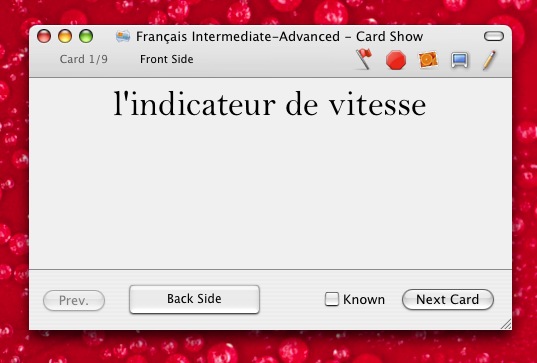 You can create your own decks in iFlash. There isn't a way to clip articles or notes from the web like in SuperMemo or Mental Case.
The developer is working on iFlash Touch for use on the iPhone and iPod Touch devices directly (i.e. it runs as actual software and is not just photos as is the case with Mental Case).
 Mental Case has the most attractive user interface of all three Mac programs. Although not as full featured as SuperMemo, it is probably the most like SuperMemo in the Max OS X world.
Mental Case, similar to SuperMemo, allows one to take clips and notes from the internet or other programs and create notes to review in Mental Case later. The software can create flash cards in iPhoto for downloading to your iPod or iPhone for later review.
Unfortunately, there aren't a lot of user-created decks for Mental Case that I can find. You will have to create your own and find a place to share them with others without developer support, as iFlash enjoys.
Interestingly, none of the popular language software programs, such as Rosetta Stone, use the interval learning algorithm, unfortunately, although research has shown that retention of language is easier using it, instead of the usual methods. Instead, they rely on rote memorization and ill-spaced learning.
Yet, students in less-affluent countries use SuperMemo to learn English and other languages rather than the more expensive language software courses. They find that they retain the language longer, learn it faster and with less work. More importantly, they become more proficient in the language making it easier to find jobs in the West.
You can use the interval learning algorithm to learn anything, not just language. There are decks on just about every topic under the sun for SuperMemo and iFlash. You can create your own for these and any of the other software, of course.


